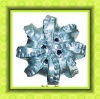
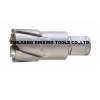
Diamond tools matrix or tungsten matrix PDC Bit
HM6193 Series
IADC:M323
· 6-blade, large PDC cutters;
· Backup cutters are located on each blade to restrict cutting depth, reduce torque fluctuation and extend bit service life;
· Medium parabolic profile and heavy cutter density provide good penetration rates in medium to hard formations with medium compressive strength and small abrasive layers;
· Deep blade configuration makes it possible to obtain high ROP in soft to medium formations and provide effective cooling to formations with certain abrasiveness;
Bit Type | Bit Specification | Recommended Operation Parameters |
Size (Inches) | No. Of Nozzles | Gauge Length (Inches) | API Reg. Pin Conn. (Inches) | Hydraulic Flow Rate | Rotation Speed | Weight On Bit |
| 1/s | gpm | (r/min) | kn | klbs |
| HM6193B | 12-1/4 | 3R+3F | 3-7/8 | 6-5/8 | 40~60 | 630~950 | 60~300 | 40~140 | 9~30 |
| HM6193BL | 9-1/2 | 3R+3F | 3-7/8 | 6-5/8 | 35~50 | 550~790 | 60~300 | 20~130 | 5~29 |
| HM6193 | 8-1/2 | 3R+3F | 2-3/4 | 2-3/4 | 24~42 | 380~670 | 60~300 | 20~110 | 5~25 |
Note: We can design and manufacture any types and sizes of PDC bits according to customer requirements.
Recommended Diamond Bit Operation Procedure
Preparation Before Drilling
l Inspect previous bit for body damage, lost cutters or inserts, etc. Make sure no hard objects exist at bottom hole such as teeth, tungsten carbide and steel pieces. Clean the bottom if necessary.
l Handle the bit with care. Place the bit on wooden pad or rubber mat. Do not set the bit directly on the steel floor.
l Check the cutting elements for damage and inside of bit for any foreign matter and Install nozzles properly as requested, ensure that nozzle O-ring are in place.
Making Up the Bit
l Clean and grease the pin or box.
l Fit the breaker to the bit, lower the drill string to the pin and engage the threads.
l Locate the bit and breaker into the rotary bushing, and make-up to the recommended torque.
Tripping Down the Hole
l Remove the breaker and carefully lower the bit through the rotary table, BOPs and hangers.
l Pay attention to the presence and location of tight spots encountered when pulling the previous bit out of the hole. Trip bit slowly through tight spots, dog legs or ledges.
l Wash the bottom hole with rated flow at 60rpm when the drill string is approximately 30m from the bottom.
l Approach the bottom cautiously by observing the weight and rotary-torque indicators. Tag bottom gently and pick up approximately half a meter off bottom. Circulate for 5 to 10 minutes with rated flow.
Reaming
l Reaming long sections of under gage hole with a diamond bit is not recommended.
l If reaming is necessary, ream slowly with low torque at rated flow rate, 60 rpm and 10 to 20KN weight-on-bit.
Bottom-Hole Patterning
l Lower bit to bottom at rated flow rate.
l Drill slowly using 10 to 20kn weight-on-bit and 60rpm to establish the bottom-hole pattern for at least one meter.
l Increase the weight at 10kn increments to determine optimum drilling weight-on-bit.
l While maintaining constant weight-on-bit, regulate the rotary speed to determine optimum drilling parameters.
Drilling
l Reduce rotary speed when drilling through abrasive or hard sand mud-rock stringers to extend bit life.
l Adjust the rotary speed and weight-on-bit as formation changes or stringers are encountered to maintain optimum drilling performance.
l After making connections, note the following points
u Reset pump strokes and check standpipe pressure.